
Revenue Cycle Management Intelligence
Accelerate Revenue. Reduce Denials. Improve Cash Flow.
Unity's RCMIQ automates and optimizes the complete revenue lifecycle — from patient registration and eligibility verification to coding, claims, denials, payments, and executive financial reporting.
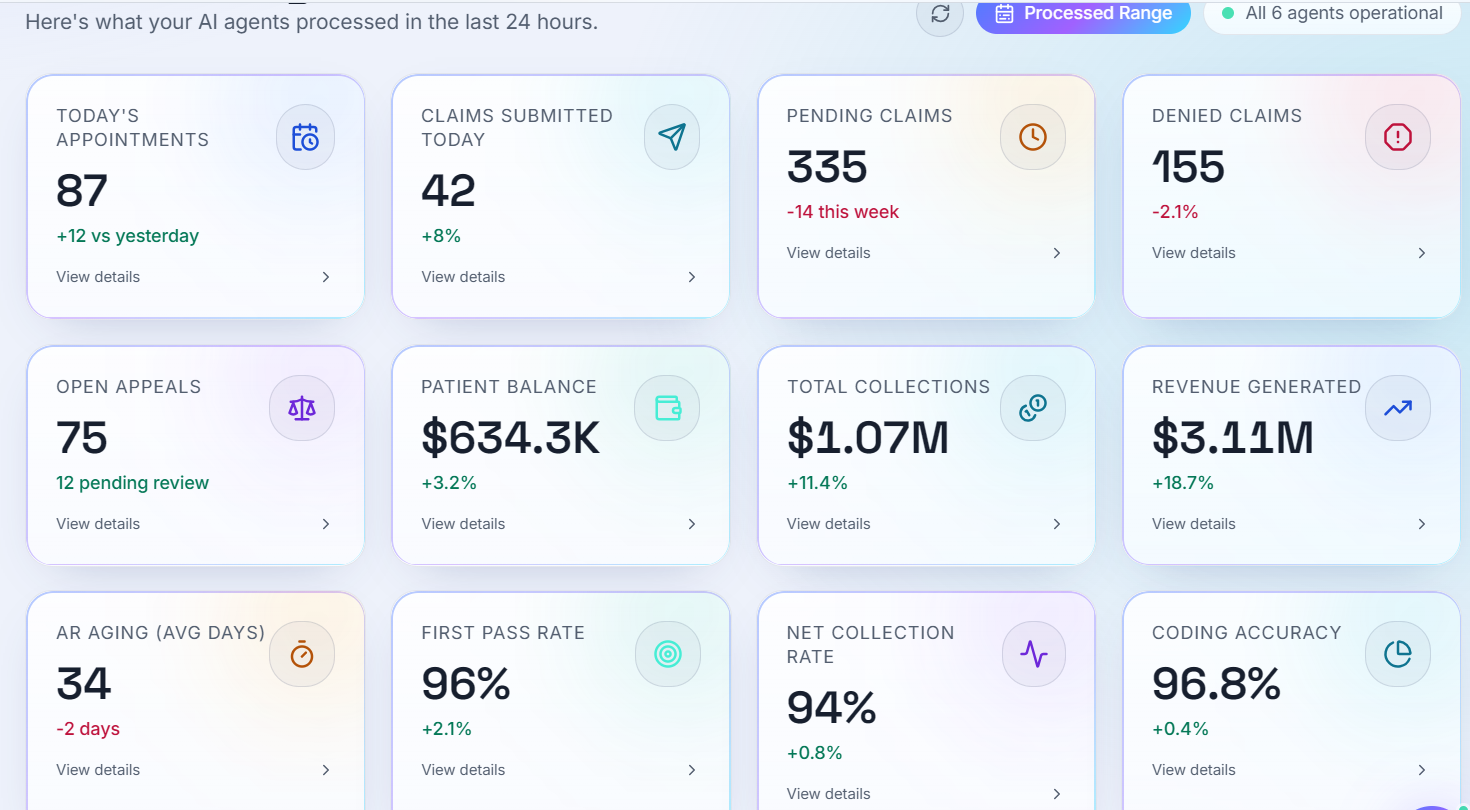
Revenue Cycle Dashboard
Demo mode · synthetic dataWhat the RCMIQ agents processed in the selected range.
Processed range: 2026-09-21 → 2026-10-20
End-to-end revenue intelligence.
Purpose-built modules covering every stage of the revenue lifecycle.
Patient Registration Intelligence
Automatically validate patient demographics and insurance information before services are rendered.
Eligibility Verification
Real-time insurance verification to reduce claim rejections before submission.
Medical Coding Intelligence
AI-assisted ICD-10, CPT, and HCPCS coding recommendations to improve coding accuracy.
Claims Management
Automatically prepare, validate, and submit clean claims with fewer errors.
Denial Prevention & Recovery
Identify denial patterns, recommend corrective actions, and prioritize high-value appeals.
Payment Posting
Automate payment reconciliation and identify outstanding balances.
Accounts Receivable Intelligence
Monitor aging reports, prioritize collections, and improve cash flow visibility.
Financial Analytics
Executive dashboards for net collection rate, first-pass claim rate, denial rate, days in A/R, revenue leakage, collections, and reimbursement trends.
Every claim validated before submission.
A continuous revenue intelligence loop — from registration to executive dashboards.
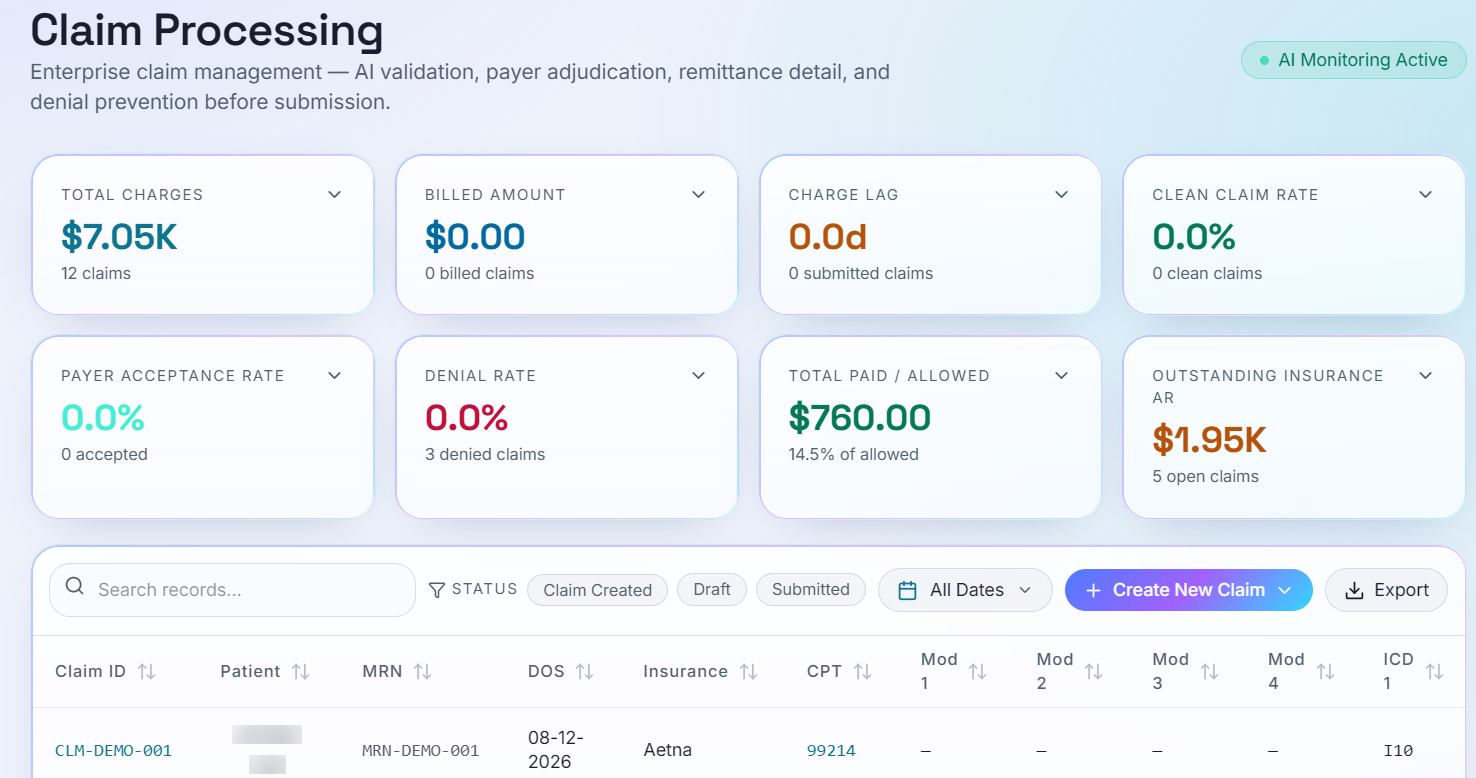
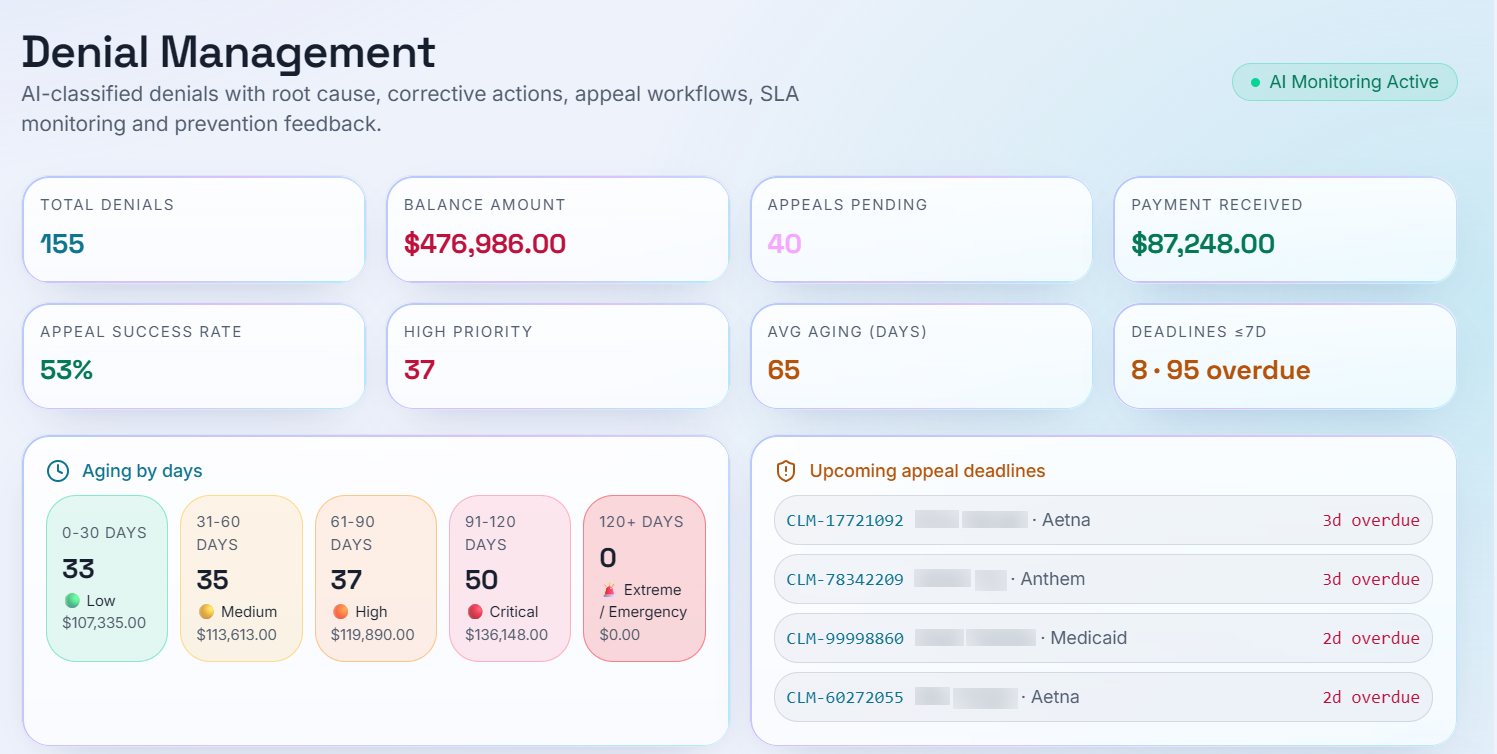
Stop denials before they happen.
RCMIQ classifies denials by root cause, prioritizes appeals by expected recovery value, and auto-generates appeal packets — turning a reactive workflow into a predictive one.
- AI-classified denials by root cause across payers and CPTs
- Prioritized worklists ranked by overturn probability and value
- Auto-generated appeal packets with supporting documentation
- Pattern detection flags systemic denial drivers before they scale
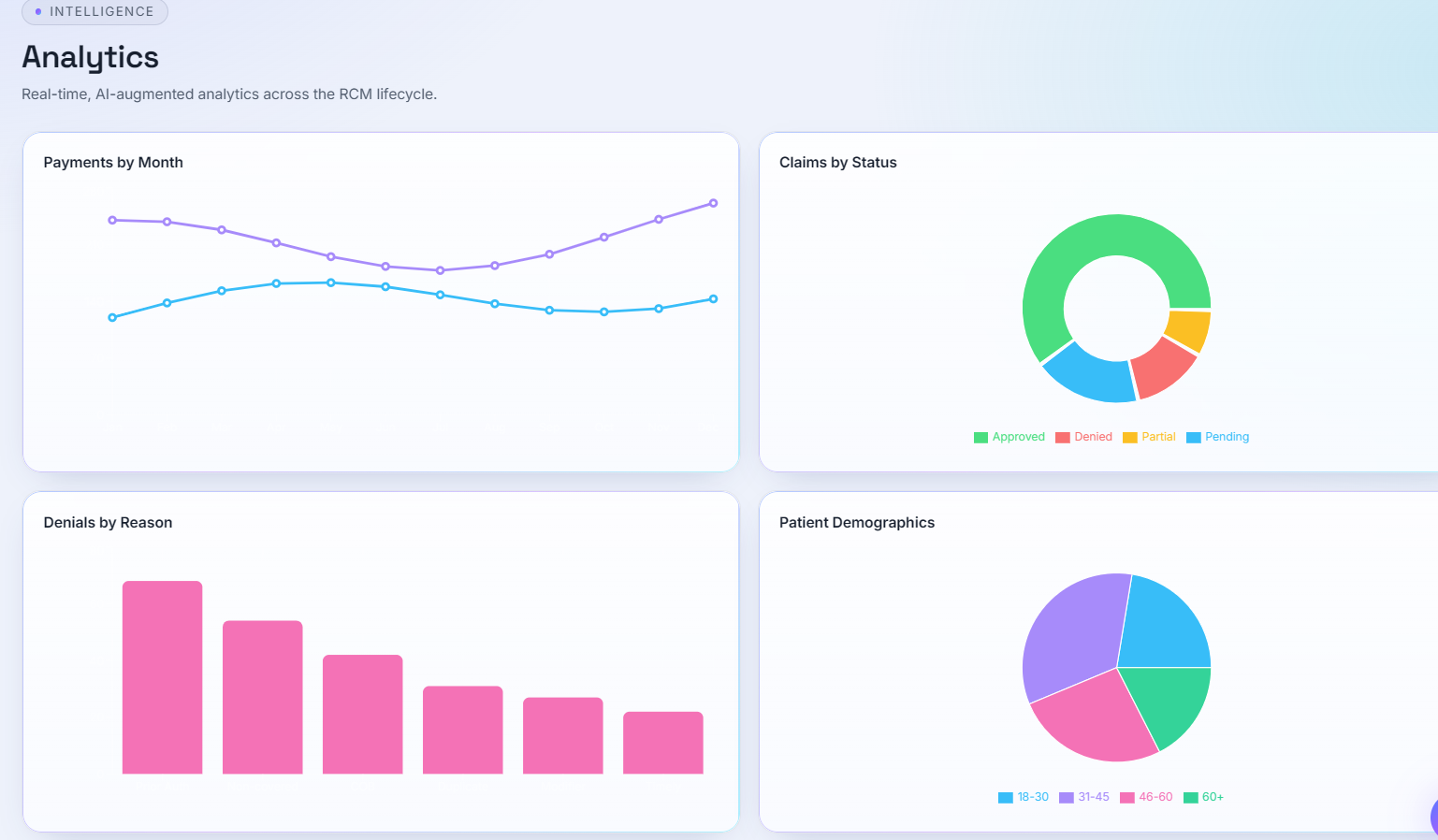
Executive dashboards for revenue performance.
Real-time visibility across the KPIs that drive financial performance — with drill-down from executive summary to individual claim.
Net Collection Rate
Reimbursement performance vs. contracted rates.
First-Pass Claim Rate
Clean-claim submission and payer acceptance.
Denial Rate
Volume, value, and root-cause segmentation.
Days in A/R
Aging velocity across payer and provider cohorts.
Revenue Leakage
Underpayments, missed charges, and lost reimbursement.
Collections Trend
Cash posted vs. expected across periods.
Outcomes healthcare organizations can expect
Financial and operational impact delivered through bounded automation and executive intelligence.
01
Faster Claims Processing
02
Reduced Claim Denials
03
Improved Revenue Capture
04
Lower Administrative Costs
05
Better Cash Flow
06
Higher Collection Rates
07
Improved Coding Accuracy
08
Executive Financial Visibility
Revenue cycle leadership profiles
Purpose-built intelligence surfaces for each function of the revenue organization.
Business challenge
Revenue leaks between claims, denials and follow-up.
Revenue cycle teams work claims, denials and payer responses across separate queues. When status is spread across systems, denials are caught late and follow-up depends on manual tracking.
- Denials discovered after the fact
- Manual claim status tracking
- Limited visibility across the revenue cycle
Data fragmentation
The revenue cycle runs on disconnected records.
Claims, remittances, denial reasons and patient account activity typically live in different systems and reports.
- Claims
- Remittances
- Denial reasons
- Payer responses
- Patient accounts
- Billing reports
UnityIQ intelligence layer
From fragmented data to decision-ready intelligence.
RCM IQ brings claim and denial activity into one intelligence layer, so teams can see where revenue is at risk and what to work next.
- 01 · Data
Claims, remittances and denial records
- 02 · Intelligence
Denial patterns and claim status in one view
- 03 · Decision
Which claims and denials to prioritise
Workflow
How RCM IQ moves from input to action.
Each step runs inside approved guardrails, with people deciding where judgment is required.
- 01 · Input
A claim is submitted or a denial is received
- 02 · Intelligence
Status and denial reason are reconciled against history
- 03 · Decision
The claim is prioritised for correction or appeal
- 04 · Agent
Agents check policy and summarise the work queue
- 05 · Action
Billing teams correct, resubmit or appeal
Business outcomes
Operational outcomes.
- Earlier denial detection
- Better prioritisation of claim work
- Improved revenue cycle visibility
- Reduced manual status tracking
Related
Related industries and case studies.
Solutions
Industries
Case studies
Build your intelligence layer
Build Your Organization's Intelligence Layer
Transform fragmented operational data into searchable, visual, decision-ready intelligence — with bounded automation and human override built in.
Executive briefing
60–90 minutes of focused discovery.
Intelligence map
Tailored to your domains and decision surfaces.
Strategic roadmap
From fragmentation to bounded automation.